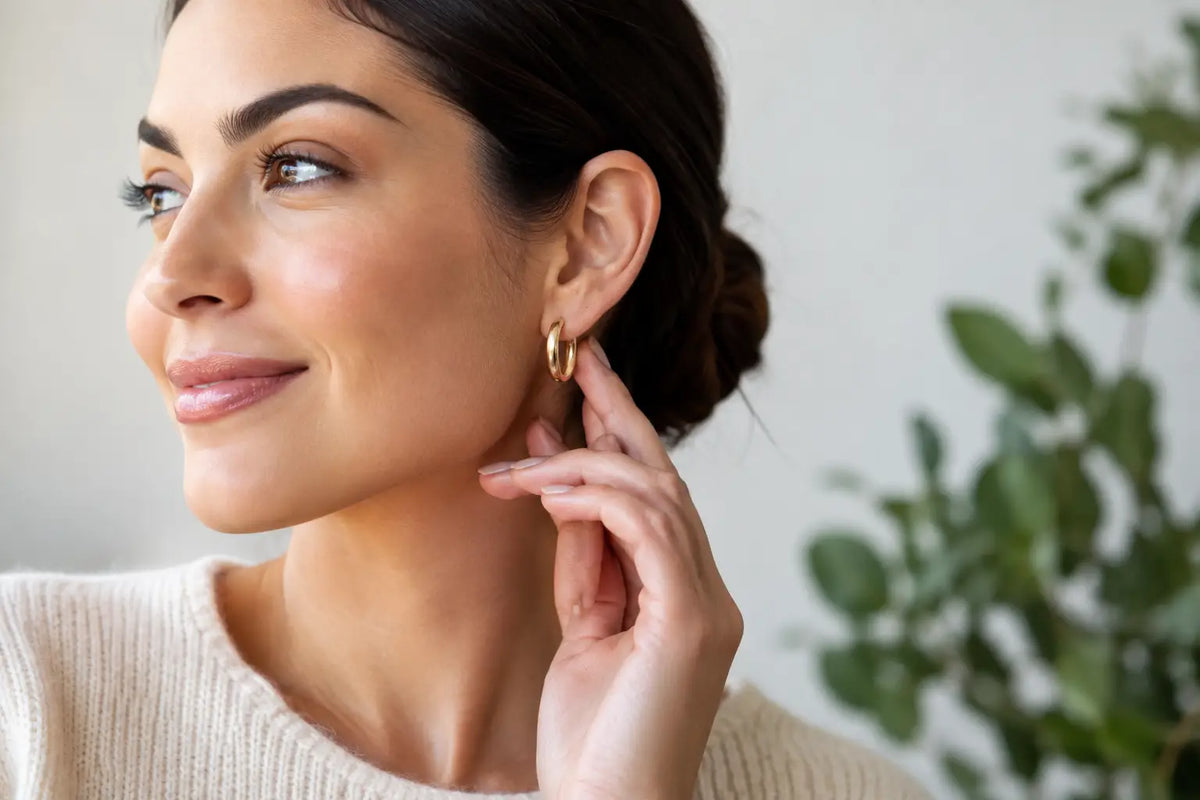
How to Choose Huggie Sizes That Feel Just Right
A huggie that sits close to the ear can make the simplest outfit feel instantly polished. But knowing how to choose huggie sizes is what turns that neat, luminous look into an earring you will genuinely want to wear from morning coffee to evening plans. Too small, and the hoop can pinch or refuse to click closed. Too large, and it loses the close, curved finish that makes huggies so flattering.
The right size is less about one universal measurement and more about your piercing placement, lobe shape and the look you want. A tiny hoop can be beautifully refined in a second piercing, while a slightly roomier style may feel far more comfortable in a first lobe piercing. Here is how to find your just-right fit.
How to Choose Huggie Sizes for Your Piercing
Huggie sizes usually refer to the hoop's inner diameter - the open space inside the hoop, measured in millimetres. This is the figure that determines whether the earring has enough room to wrap around your ear comfortably.
For most lobe piercings, huggies between 8 mm and 10 mm are a dependable starting point. An 8 mm hoop creates a very close, minimal finish on a slim or high lobe piercing. A 9 mm or 10 mm huggie offers a little more breathing room, which often suits a lower piercing or a fuller lobe better.
Smaller styles, often around 6 mm to 7 mm, are usually best for second or third lobe piercings where the piercing sits nearer the edge of the ear. They can also work in certain cartilage placements, though cartilage anatomy varies much more from person to person. Larger 11 mm to 12 mm huggies still feel compact and elegant, but bring a softer, less fitted silhouette to the lobe.
Think of the size as a styling choice as well as a comfort decision. The closer the hoop, the cleaner and more understated the effect. A little extra space lets a charm, pearl drop or sparkling zircon detail move and catch the light.
Measure Before You Choose
You do not need specialist tools to get a useful estimate. Start by looking at the distance between your piercing and the lower edge of your lobe. A small ruler with millimetre markings is helpful, but a strip of paper and a ruler can work just as well.
Measure from the centre of your piercing to the edge of your ear, then add around 1 mm to 2 mm for comfort. If that distance is 4 mm, for example, an 8 mm inner diameter is likely to give a close fit. If it is nearer 5 mm, a 9 mm or 10 mm hoop will usually be more comfortable.
This is only a guide, because ears are not flat. The thickness of your lobe matters too. A piercing that sits centrally through a fuller lobe may need more room than the same measurement on a thinner ear. If you are choosing between two sizes, go slightly larger for a first lobe piercing, particularly if you like to leave your earrings in overnight.
It also helps to check where your piercing sits from front to back. A hoop has to travel around the entire lobe, not only across its front. A huggie that looks as though it should fit from the front can feel unexpectedly tight once it reaches the back of the ear.
Do Not Judge Size From Product Photos Alone
Close-up jewellery photographs make even an 8 mm hoop look larger than it is. Look for the inner diameter in the product details, then compare it with a hoop you already own and wear comfortably. This is often the simplest way to shop with confidence.
If you have a pair of huggies that fit beautifully, lay one flat and measure the open space inside the hoop rather than the full outside width. The outside diameter includes the metal and any stone setting, so it can make the earring appear larger on paper than it feels on the ear.
Match the Hoop to Its Placement
First lobe piercings usually have the most room and can carry the widest choice of huggie sizes. A 9 mm or 10 mm hoop is an easy everyday option: close enough to look intentional, with enough clearance for comfortable wear. If your first piercing is especially low, try an 11 mm or 12 mm design rather than forcing a smaller hoop to sit too tightly.
Second and third lobe piercings often suit 6 mm to 8 mm huggies. These smaller hoops create the neat, stacked jewellery look without competing with your main pair. A polished mini hoop beside a zircon huggie, pearl accent or small stud gives your ear stack dimension while keeping it refined.
Cartilage placements need a more individual approach. A huggie for the helix, for instance, needs to match both the piercing position and the thickness of that part of your ear. Many people need a larger inner diameter than expected, even when they want a very close look. If your cartilage piercing is new, tender or still healing, wait until it is fully healed and follow advice from your piercer before changing jewellery.
Comfort Is the Best Fit Check
A huggie should click shut without pressure. Once closed, it should sit against the ear with a small amount of space rather than pressing into the skin. It may look snug, but it should never feel restrictive.
Signs a hoop is too small include a clasp that will not close easily, redness, a noticeable dent after wearing it, or a pinching sensation when you smile, talk on the phone or sleep. Do not keep trying to fasten an overly tight huggie. Besides being uncomfortable, it can irritate the piercing.
A huggie that is too large is not necessarily wrong. It simply gives a different effect: more of a petite hoop than a true ear-hugging style. This can be ideal if you prefer movement, have sensitive lobes that dislike pressure, or want space for a decorative stone setting.
The metal matters here too. For everyday earrings, hypoallergenic, nickel-free materials such as 316L stainless steel are a thoughtful choice for sensitive skin. A smooth finish, secure hinge and lightweight feel can make as much difference to all-day comfort as the diameter itself.
Choose a Size That Suits Your Styling
For a quiet, everyday finish, choose a plain 8 mm to 10 mm huggie in a polished gold or silver tone. It brings a little shine to knitwear, tailoring and off-duty basics without asking for attention. These are the pairs you reach for repeatedly because they work with almost everything.
If you love a more luminous look, a slightly larger hoop can give zircon details space to show. Baguette-cut stones, pavé sparkle and pearl embellishments often look especially balanced at 9 mm to 12 mm, depending on the design. The added diameter makes the detail easier to see while retaining the compact elegance of a huggie.
For an ear stack, vary your sizes rather than making every hoop identical. Try a 10 mm statement huggie in the first lobe, an 8 mm textured or sparkling pair in the second, then a tiny 6 mm hoop or stud higher up. The result feels collected and personal rather than overly matched.
Gold-toned huggies bring warmth to clover motifs, pearls and soft floral details, while silver-toned styles give crystal-clear zircon and sculptural curves a cooler, modern edge. There is no fixed rule, of course. Mixing tones can look especially fresh when the shapes feel connected.
A Quick Note on Post Thickness and Closures
Diameter gets most of the attention, but the post thickness matters too. Many standard lobe earrings use a finer post, commonly around 0.8 mm, while some cartilage jewellery uses a thicker 1.2 mm post. Always check the specification if you are buying for a piercing other than a standard lobe.
Huggies typically use a hinged post that clicks into place. Before putting a new pair in, make sure the post is aligned and the closure feels secure. Never bend the post to make a size work. If the hoop does not close naturally around your ear, the diameter or placement is not quite right.
The best huggie size is the one you barely notice you are wearing, apart from the small lift of confidence every time you catch its shine in the mirror. Start with a comfortable everyday diameter, then build your collection around the placements and details you love. A well-chosen pair from Moonix can become one of those daily adornments that makes getting dressed feel effortlessly complete.